
GC-MS vs. LC-MS in Forensic Science
Understanding Two of the Laboratory's Most Powerful Analytical Tools
In forensic science, identifying a substance is rarely as simple as looking at a sample and determining what it contains. Blood, urine, seized drugs, unknown powders, environmental samples, and other evidence can contain hundreds or thousands of chemical compounds.
To separate and identify those compounds, forensic laboratories rely on sophisticated analytical instrumentation. Two of the most important technologies are gas chromatography-mass spectrometry (GC-MS) and liquid chromatography-mass spectrometry (LC-MS).
Both combine chromatography with mass spectrometry. Both can provide powerful information about the chemical composition of a sample. And both are widely used across forensic and analytical laboratories.
But GC-MS and LC-MS are not interchangeable. Understanding how they differ—and why a laboratory chooses one technique over another—can be important when evaluating forensic evidence.
First: What Do Chromatography and Mass Spectrometry Actually Do?
The easiest way to understand GC-MS and LC-MS is to separate each technique into its two components.
Chromatography separates. Mass spectrometry identifies and measures.
A forensic sample is usually a complex mixture rather than a single chemical. Chromatography separates components of that mixture so they reach the detector at different times.
Mass spectrometry then examines the molecules or ions reaching the detector. Depending on the instrument and method, the resulting mass spectral information can help scientists identify compounds and determine how much of a particular substance is present.
GC-MS and LC-MS differ primarily in how the compounds are separated and introduced into the mass spectrometer.
What Is GC-MS?
Gas chromatography-mass spectrometry (GC-MS) uses a gas chromatograph to separate compounds before they enter the mass spectrometer.
The sample is introduced into a heated inlet, and compounds capable of entering the gas phase travel through a chromatographic column carried by an inert gas. Different compounds interact differently with the column and therefore emerge—or elute—at different times.
That retention behavior provides one piece of analytical information.
The compounds then enter the mass spectrometer, where they are ionized and analyzed according to their mass-to-charge characteristics.
With commonly used electron ionization GC-MS methods, molecules can produce characteristic fragmentation patterns. Those patterns can be compared with reference spectra and other identification criteria to help determine what substance is present.
Where GC-MS Excels
GC-MS is particularly useful for compounds that are sufficiently volatile and thermally stable to survive the temperatures involved in gas chromatography.
Depending on the validated method and application, forensic laboratories may use GC-MS for:
• Volatile organic compounds
• Certain controlled substances
• Ignitable liquid and fire-debris analysis
• Solvents
• Some toxicological analyses
• Chemical unknown identification
• Certain drugs and drug metabolites
For some compounds that are not naturally suitable for GC analysis, chemical derivatization can be used to make them more amenable to the technique.
What Is LC-MS?
Liquid chromatography-mass spectrometry (LC-MS) takes a different approach.
Instead of vaporizing compounds and transporting them through a column in a gas, LC uses a liquid mobile phase to separate the components of a sample.
This makes LC-MS particularly valuable for substances that are polar, less volatile, larger, or susceptible to thermal degradation.
After chromatographic separation, compounds enter the mass spectrometer through an ionization interface. Techniques such as electrospray ionization can transfer compounds from the liquid phase into gas-phase ions suitable for mass analysis.
Modern forensic laboratories frequently use tandem mass spectrometry, commonly written as LC-MS/MS, to achieve highly selective and sensitive measurements.
Where LC-MS Excels
Depending on the method, LC-MS/MS can be particularly useful for:
• Prescription medications
• Illicit and emerging drugs
• Drug metabolites
• Synthetic opioids
• Benzodiazepines
• Cannabinoids
• Certain pesticides
• Biological molecules
• Compounds present at very low concentrations
As forensic toxicology confronts an increasingly diverse drug landscape, LC-MS/MS has become an exceptionally important analytical platform.
GC-MS vs. LC-MS: What's the Difference?
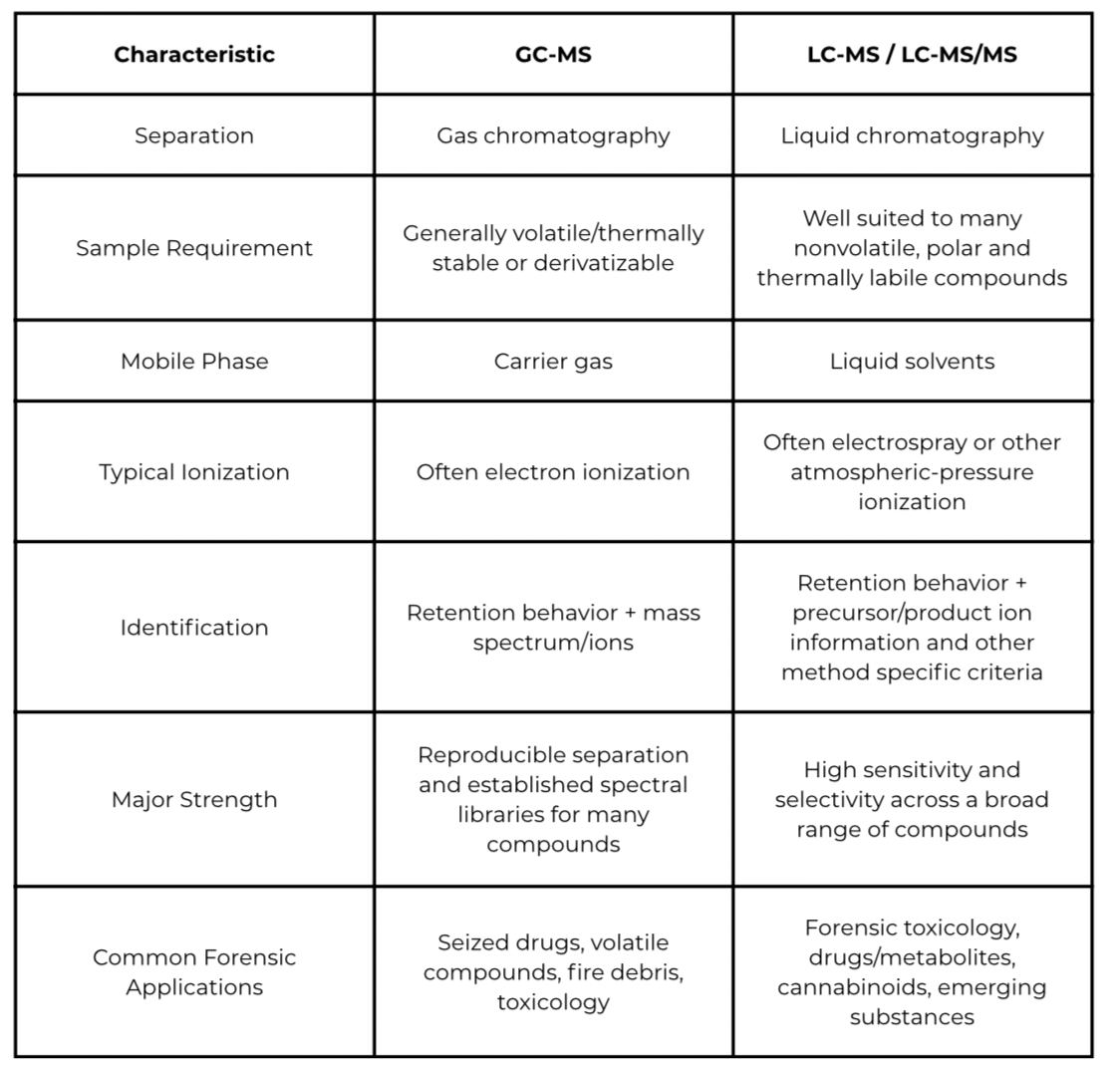
Table characterizing the differences between GC-MS and LC-MS.
Why GC-MS Has Long Been Important in Forensics
GC-MS has been a workhorse of forensic analytical chemistry for decades.
One major advantage is the reproducibility of electron-ionization mass spectra. Because many compounds fragment in characteristic ways under standardized conditions, scientists can compare an unknown spectrum against extensive reference libraries.
But library matching should not be confused with absolute proof. A scientifically defensible identification should consider the laboratory's entire validated identification scheme, which may include retention behavior, diagnostic ions, reference materials, controls, calibration data, and other criteria.
A computer saying that a spectrum "matches" a compound is only one piece of the analytical picture.
Why LC-MS/MS Has Become So Important
LC-MS/MS offers a different set of advantages.
Modern toxicology laboratories may need to identify dozens or hundreds of drugs and metabolites in complicated biological samples, sometimes at extremely low concentrations.
LC-MS/MS can provide exceptional sensitivity and selectivity for many of these compounds.
This has become increasingly valuable as forensic laboratories encounter novel psychoactive substances, potent synthetic opioids, complex prescription drug combinations, cannabinoids, and metabolites that may be difficult or impractical to analyze using traditional GC-MS methods.
But greater sensitivity does not eliminate the need for rigorous scientific controls.
More Advanced Technology Does Not Automatically Mean Better Evidence
A laboratory can use an extraordinarily sophisticated mass spectrometer and still produce a result that deserves scientific scrutiny.
The instrument is only one component of the analytical process. Reliable forensic analysis also depends on sample collection and preservation, chain of custody, sample preparation, calibration, quality controls, internal standards, method validation, interference studies, detection and quantitation limits, instrument maintenance, carryover assessment, data processing, identification criteria, analyst competency, and technical review.
The relevant question is therefore not simply: “Did the laboratory use GC-MS or LC-MS?”
It is: “Was the chosen analytical method appropriate, properly validated, correctly performed, and scientifically supported for this particular sample and analyte?”
Screening and Confirmation Are Not the Same Thing
A screening method is generally designed to efficiently identify samples that may contain particular substances or classes of substances. Depending on the laboratory and application, screening may involve immunoassays, chromatography, mass spectrometry, or combinations of technologies.
More specific analytical testing can then be used to identify and, where required, quantify particular compounds.
GC-MS and LC-MS/MS can both play roles in forensic identification, but the fact that mass spectrometry was used does not by itself answer whether a particular result satisfies the laboratory's validated identification or reporting criteria. That requires reviewing the actual method.
What Should Attorneys Look for in GC-MS or LC-MS Evidence?
When a forensic laboratory reports a drug or toxicology result, the final report may provide only a fraction of the underlying analytical information.
A meaningful independent review may require examination of the laboratory's:
• Standard operating procedures
• Method validation
• Calibration records and calibration curves
• Quality-control results
• Chromatograms
• Mass spectra or ion-transition data
• Integration records
• Batch sequences
• Internal-standard performance
• Blank results
• Reference-material documentation
• Instrument maintenance records
• Analyst notes
• Data-review documentation
The specific records needed will depend on the technique and the case. This is one reason reviewing only the final laboratory report can provide an incomplete picture of the underlying science.
A Chromatogram Is Data—not a Verdict
Both GC-MS and LC-MS generate chromatographic data.
A chromatogram displays detector response over time, producing peaks associated with compounds emerging from the chromatographic system.
But seeing a peak does not automatically establish the identity or concentration of a substance.
Scientists must determine whether the data satisfy the laboratory's validated criteria. Depending on the method, that can involve evaluating retention time, peak shape, signal-to-noise, diagnostic ions or transitions, ion ratios, calibration performance, internal standards, interferences, blanks, and quality-control samples.
This is where experienced scientific review becomes particularly valuable.
The Right Question Is: Was the Method Fit for Purpose?
Forensic analytical chemistry is not a competition between instruments.
GC-MS may be an excellent technique for one analytical problem while LC-MS/MS may be far better suited to another. Sometimes laboratories use complementary techniques because each provides different information.
What ultimately matters is whether the laboratory selected a method capable of reliably answering the scientific question presented by the evidence—and whether the data support the conclusion reported.
Why Independent Review Matters
Modern analytical instruments are extraordinarily powerful. But sophisticated instrumentation should not make forensic evidence immune from scrutiny.
In many cases, meaningful scientific review requires looking beyond the laboratory's final reported number or identification and examining the underlying analytical data.
At Medusa Analytical, our scientists evaluate forensic laboratory evidence from the perspective of analytical chemistry: how the sample was handled, how the method was validated, how the instrument performed, whether quality controls met acceptance criteria, and whether the underlying data support the laboratory's conclusion.
Because in forensic science, the question should never simply be whether a sophisticated instrument produced a result.
The question is whether the science supports it.
Need Help Understanding GC-MS or LC-MS Evidence?
Medusa Analytical provides independent forensic laboratory data review, analytical chemistry consulting, and expert witness services for attorneys handling cases involving toxicology, controlled substances, cannabinoids, blood alcohol testing, and other chemical evidence.
Our scientists can help attorneys understand not only what a laboratory reported, but how the laboratory reached that conclusion—and whether the underlying science supports it.